
Planning your grain shed loading method during the design stage ensures your shed can be filled efficiently – and to capacity.
The purpose of this article is to help growers choose a grain shed loading method and a shed design that:
- maximises shed capacity
- is efficient at harvest
- is suited to the type of grain being stored
- and is cost-effective for on-farm storage
We discuss three grain shed loading methods and how they impact cost, efficiency and capacity.
Top 3 Grain Shed Loading Methods (Pros, Cons & Ideas)
There are three main methods used for loading grain sheds:
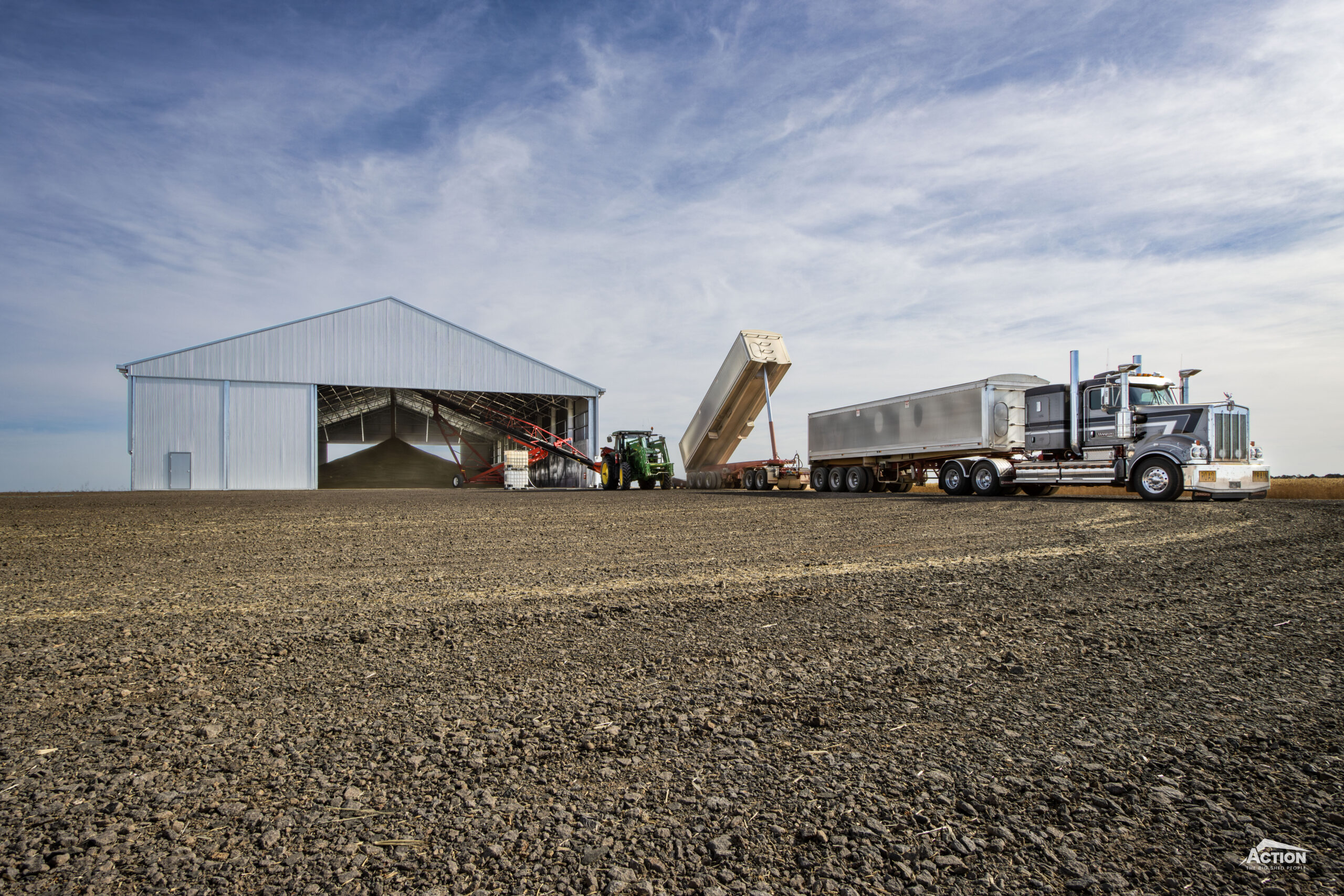
- With an auger or conveyor
- With an overhead loading system
- By tipping inside and pushing the grain stack up with a pusher bar or loader bucket.
For each method, we cover what it suits, the trade-offs, and design ideas to help you load efficiently and hit your target capacity.
1
1. Auger Or Conveyor Loading Method
This method is easily the most common for on-farm storage, and is done either:
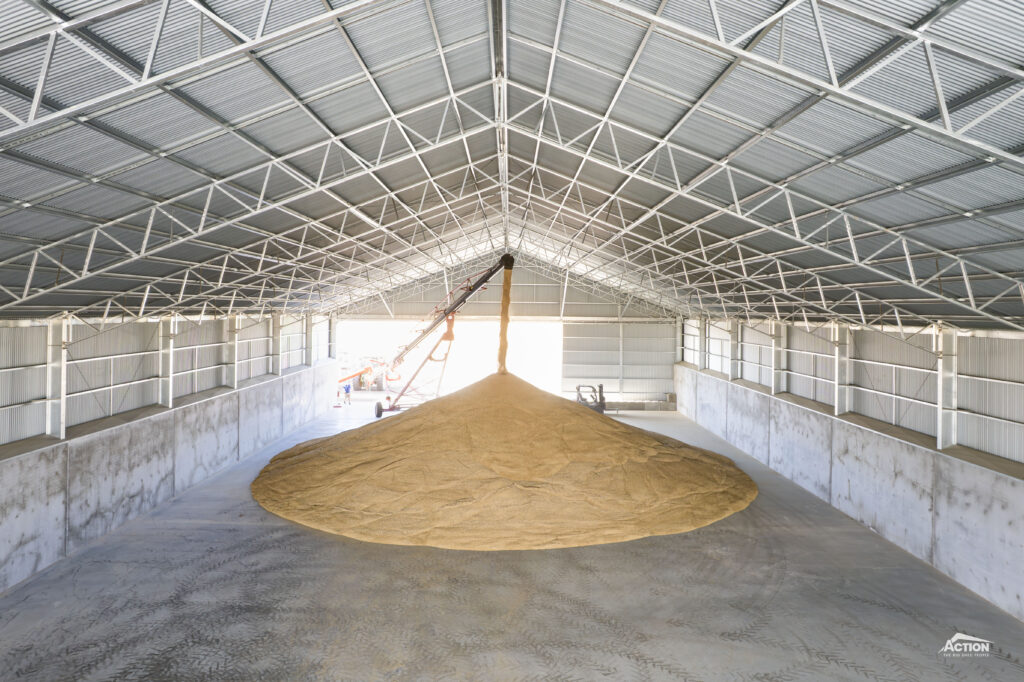
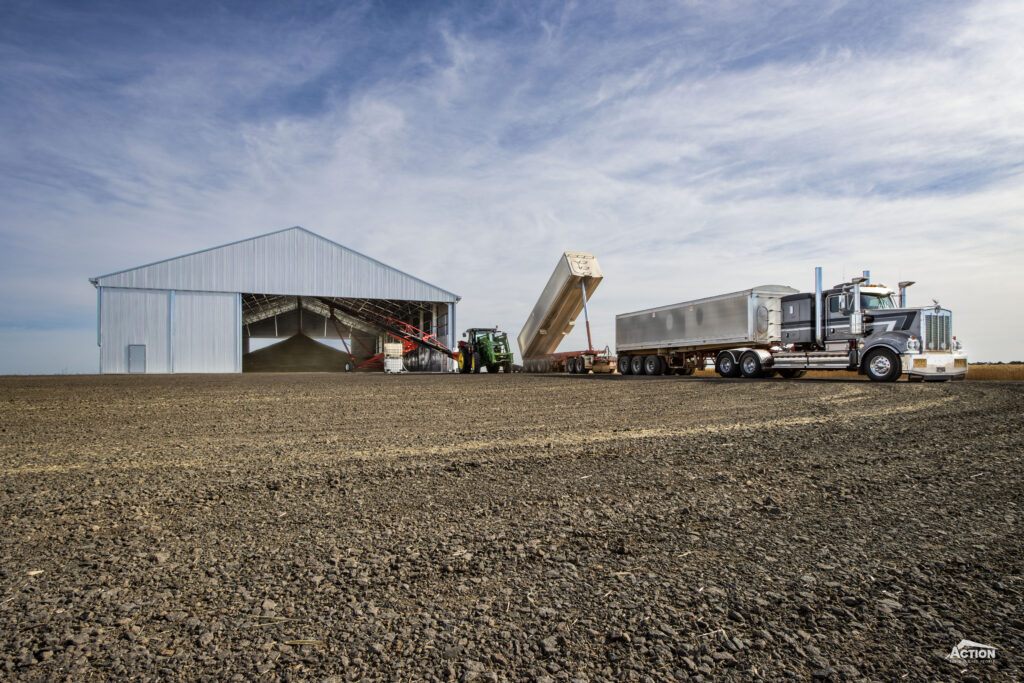
- Within the shed, where trucks tip into and fill, or
- From outside the shed – through the roof (e.g. through ground-operated roof hatches)
The reason loading a grain shed with an auger or conveyor is most popular is because it is the most effective way, if done right. It is a simple and flexible loading method.
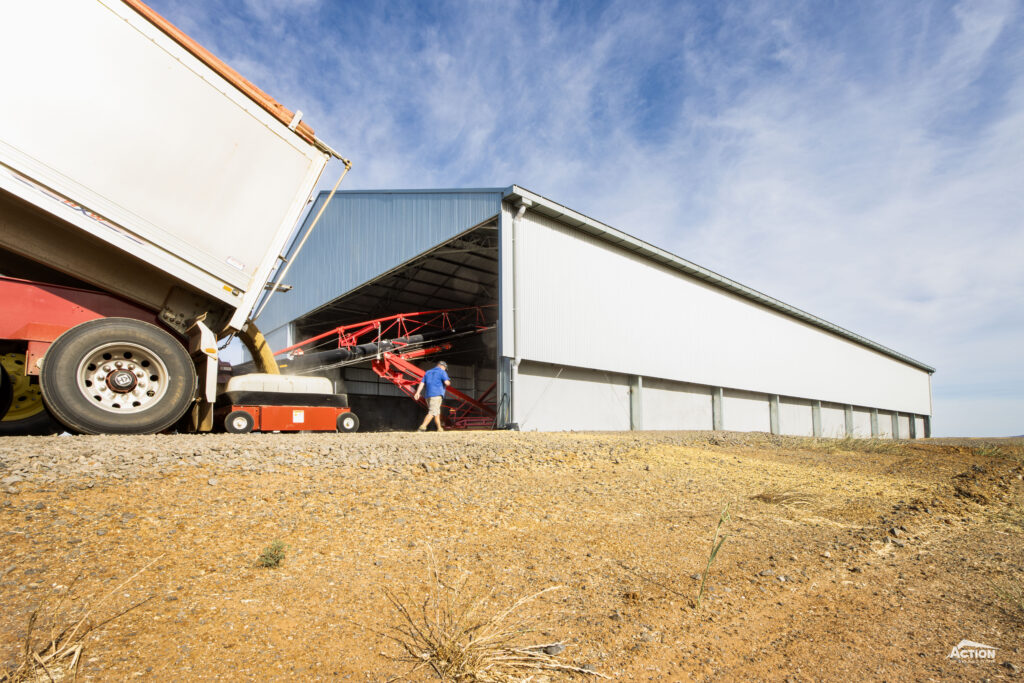
The downsides to this system are:
- You need to have the right loading gear – an auger or conveyor.
- This system isn’t suited to all grains. For example, while conveyors can be used for pulses such as beans, augers can damage them and cause them to be downgraded.
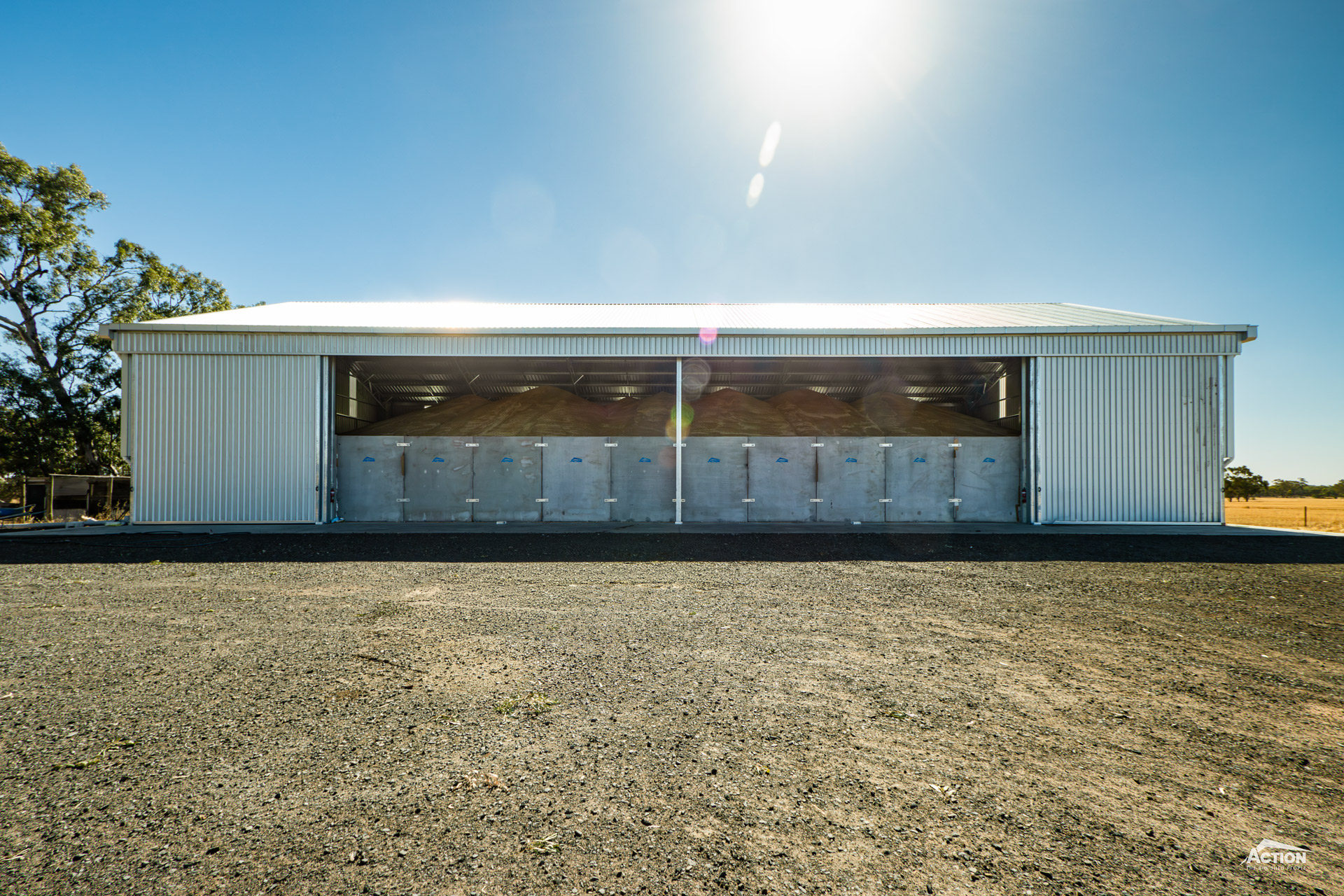
- If you are filling within the shed and the auger isn’t long enough, the grain stack will reach the auger at ground level before the stack reaches the top of the concrete walls. This is due to the natural angle of repose of grain.
To avoid this issue, you can choose a narrower span to suit the reach of your auger, so the grain naturally peaks at a lower height overall. As a result, there is less distance between the peak and where the stack reaches ground level. This means that you are more likely to achieve the maximum capacity of the shed.
However, the downside to a narrow grain shed is that you may limit the ability to turn trucks around inside.
Another potential workaround is to install a shield that allows the auger to stay in position, helping to maximise capacity.
2
2. Overhead Loading System
An overhead loading system is typically most common for grain sheds at commercial sites that handle a very high volume of grain.
Trucks tip into a drive-over hopper (or pit), which is then elevated to the roof of the grain shed.
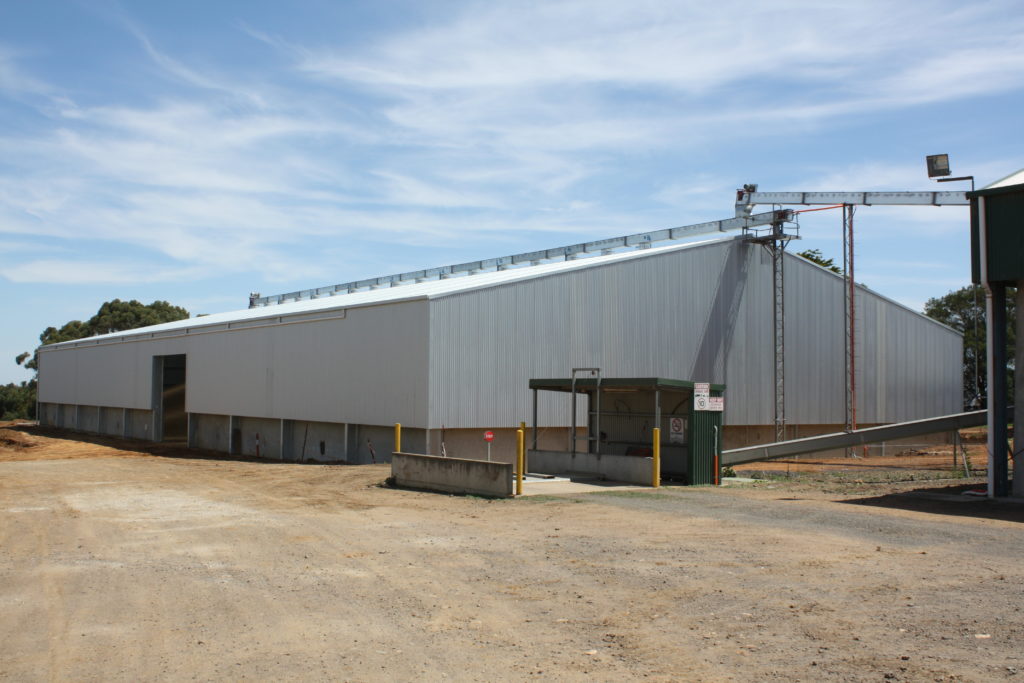
The advantage of an overhead loading system is the ability to move a high volume of grain with minimal manpower required.
There is also no need to be inside the shed, making it safer and more efficient – and therefore, the ideal system for commercial sites.
The downside is the cost. That includes the cost of the system itself and the upgrades to the shed frame so that it can support the system.
As a result, an overhead loading system is likely cost-prohibitive for most on-farm storage systems.
There are some lower-cost systems available that may be suitable for on-farm storage; however, they potentially wouldn’t have the capacity or loading speed to keep up with the operation.
3
3. Tip & Push Grain Shed Loading Method
The tip and push method – as the name suggests – is simply done by trucks tipping grain onto the shed slab, and a loader with a pusher bar pushing the stack up.
The main advantage of this loading method is the speed.
This method is the quickest way to get grain off the paddock and into storage, allowing the headers to keep harvesting!

This is why it is most common with larger cropping operations with multiple headers.
Another reason why growers choose the tip and push method is that augers can damage pulses and result in them being downgraded.
The trade-offs are capacity and labour – the maximum shed capacity won’t be achieved, and more manpower (such as loader drivers) will be required.
And the shed will also need to be reasonably high to allow trucks to tip throughout.
What Is The Best Way To Load My Grain Shed?
For most cropping operations, the best grain shed loading method comes down to:
- Auger or Conveyor Through The Roof (Maximum capacity)
- Tip & Push (Most efficient and best option for pulses)
We can also design your grain shed to work with both (keeping in mind that this won’t be the best option for pulses).
The grain shed design could look like this:
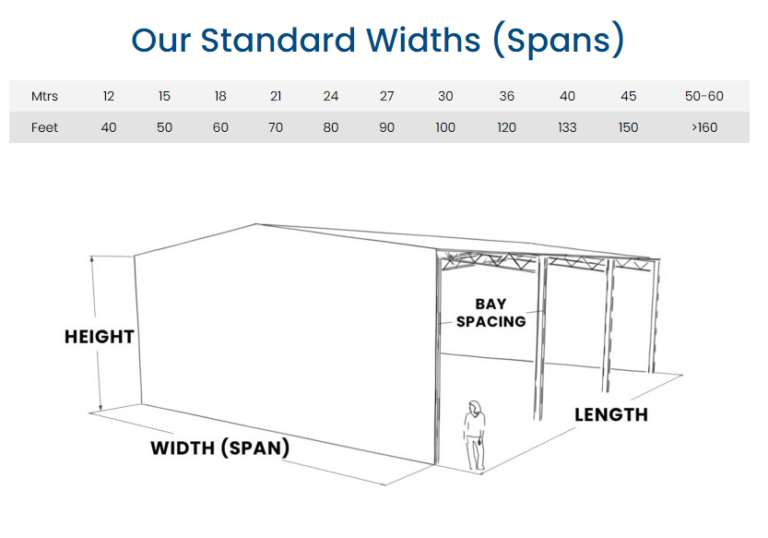
- 27 metre span (this allows a truck to turn inside the shed).
- 6.75 metre eave height and a 21-degree roof pitch (this is high enough for internal tipping through the centre only, and low enough at the eaves to achieve filling externally through roof hatches – with the right auger).
Next, we discuss grain shed designs to suit your auger.
Matching Your Grain Shed Design To Your Auger Size
It is understandable if you prefer not to outlay $100,000 on an auger just to be used for loading your grain shed.
This is often the case with growers using a grain shed as one part of a larger overall storage strategy (i.e. also using silos and bunkers).
If you are aiming to design your shed around the auger you already own, Action’s building consultants can help.
When compiling your grain shed design options, our team will match your auger type to:
- Optimum shed widths to achieve maximum capacity when filling inside.
Or
- Optimum shed widths and eave heights when filling externally through the roof to ensure the auger clears the gutter and reaches the centre of the shed.
For example, the grain shed sizes below work with 125-foot augers loading through the roof.
- 24m (W) x 45.5m (L) x 6.75m (H) shed works with a 125-foot Brandt 16125 HP Auger
- 27m (W) x 91m (L) x 6.75m (H) shed works with a MKX160 125 foot Westfield Auger
Action building consultants can also advise on grain shed designs that accommodate both using an auger externally and tipping and pushing up internally, as discussed earlier.
We hope this discussion on grain shed loading method, and considerations for capacity, grain types and efficiency has been helpful!
Useful Resources
- Grain Storage Calculator
- Craig’s 24m Span Grain Shed With Canopies (Video)
- What Is The Future Of Grain Shed Design?
How you load your grain shed should be one of the main drivers of grain shed design.
Designing your grain shed correctly upfront will ensure it can be loaded efficiently and filled to capacity – without being cost-prohibitive or lowering ROI.
Our building consultants can take you through the grain shed design process, which considers details such as loading methods, grain type and segregation requirements to arrive at the ideal grain shed for your operation.
Book a grain shed project consultation today on 1800 687 888, or email us at [email protected]