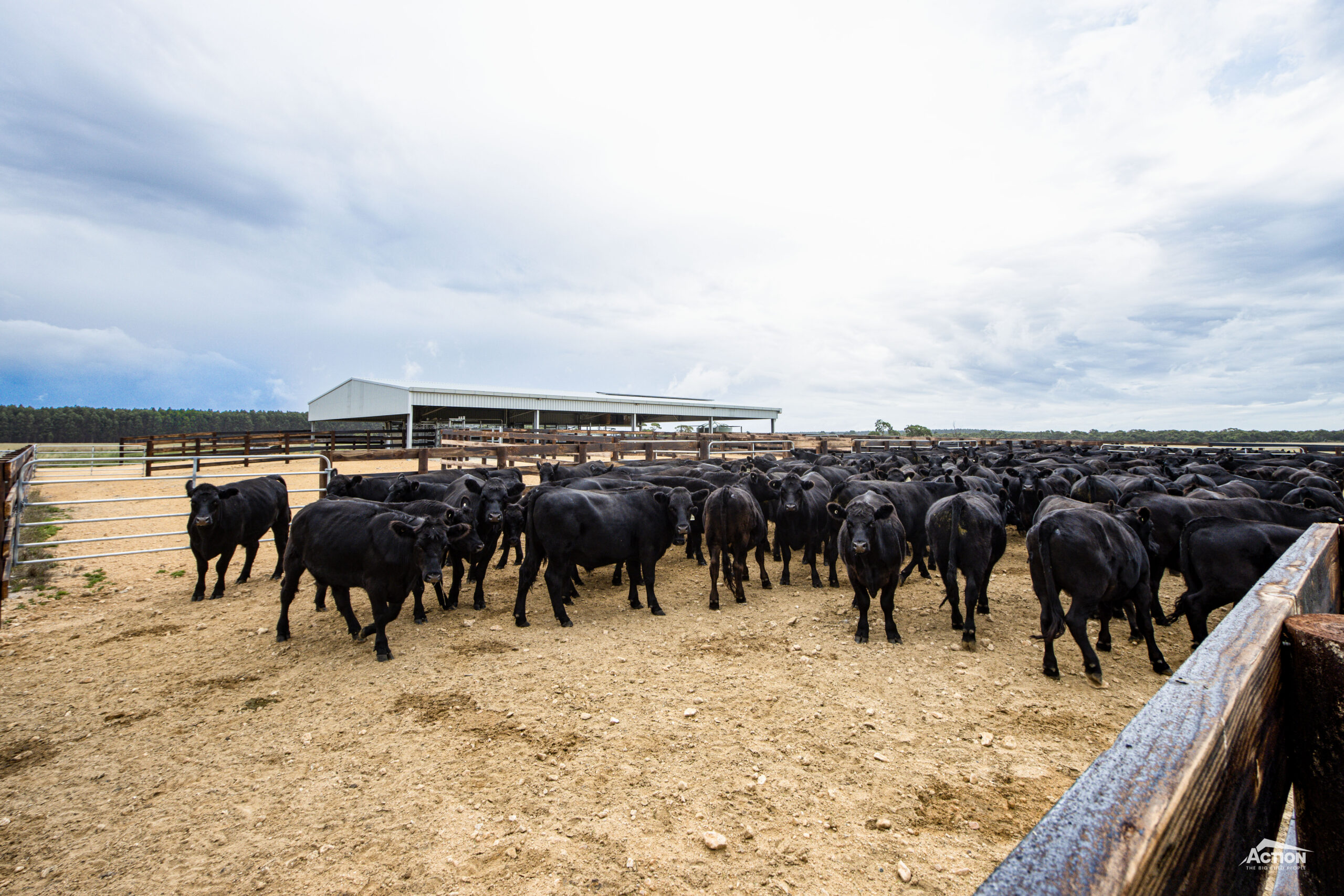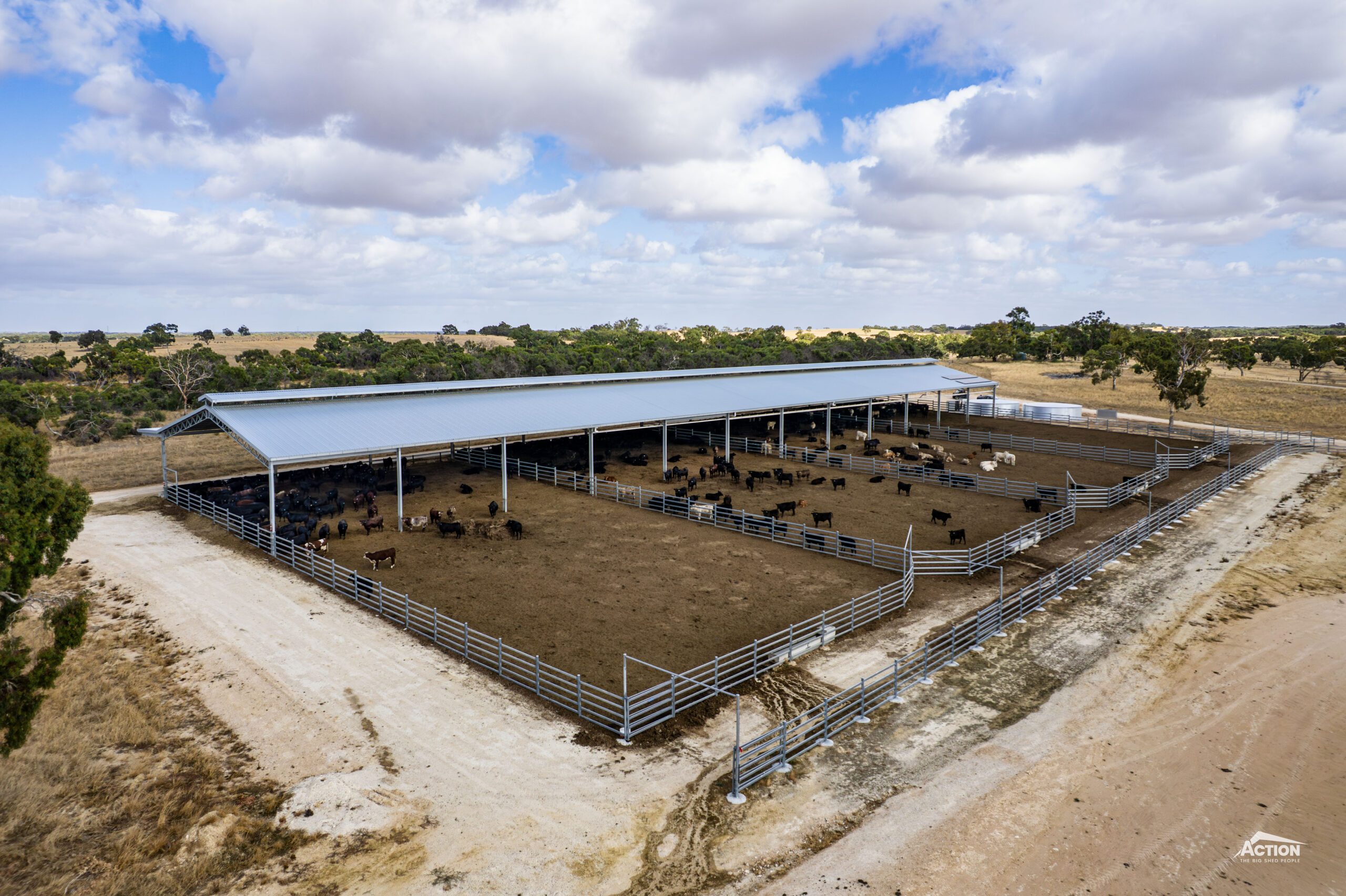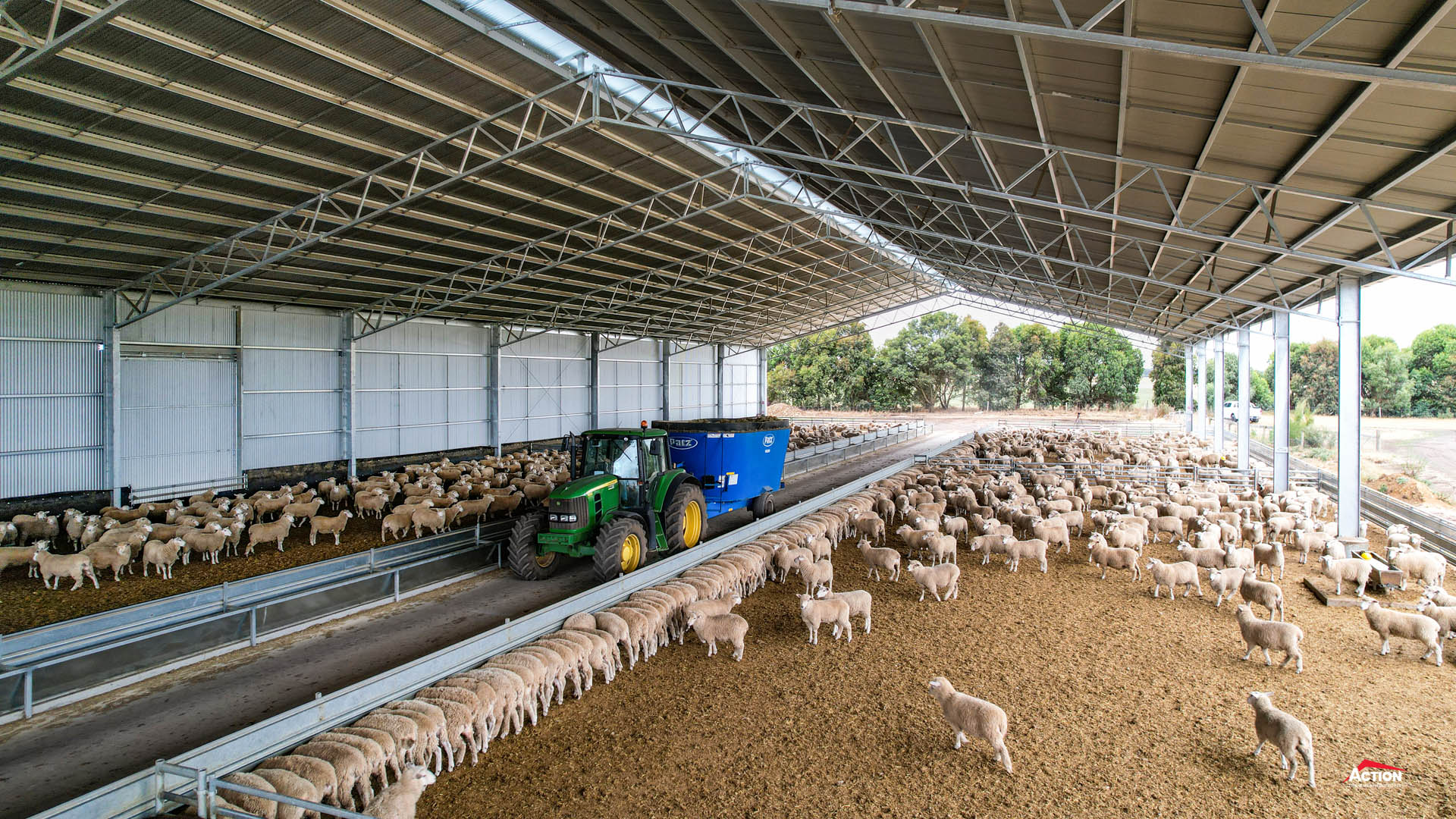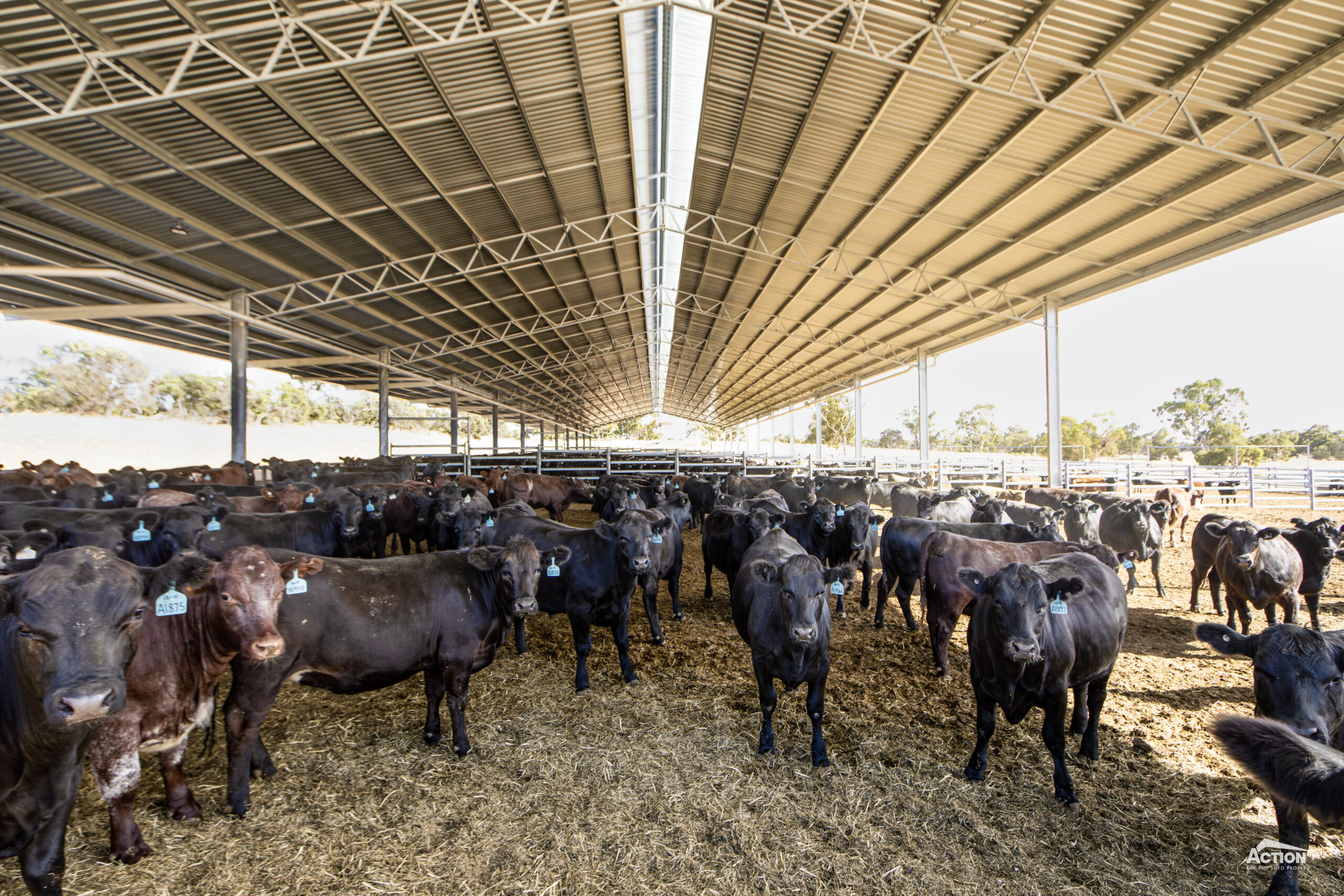
As lamb feedlot sheds become more common, so do the questions.
Successfully implementing a lamb feedlot with contained housing requires careful planning and budgeting, and having a clear understanding of your operational goals.
Got lamb feedlot shed questions? We’ve got answers!
In this article, we answer the top questions we are asked about lamb feedlot sheds, including topics like sizing, pricing and best-practice design.
If you are embarking on a lamb feedlot shed project, this is a practical place to start.
Top 10 Questions About Lamb Feedlot Sheds – Answered!
1
1. What Is A Lamb Feedlot Shed?
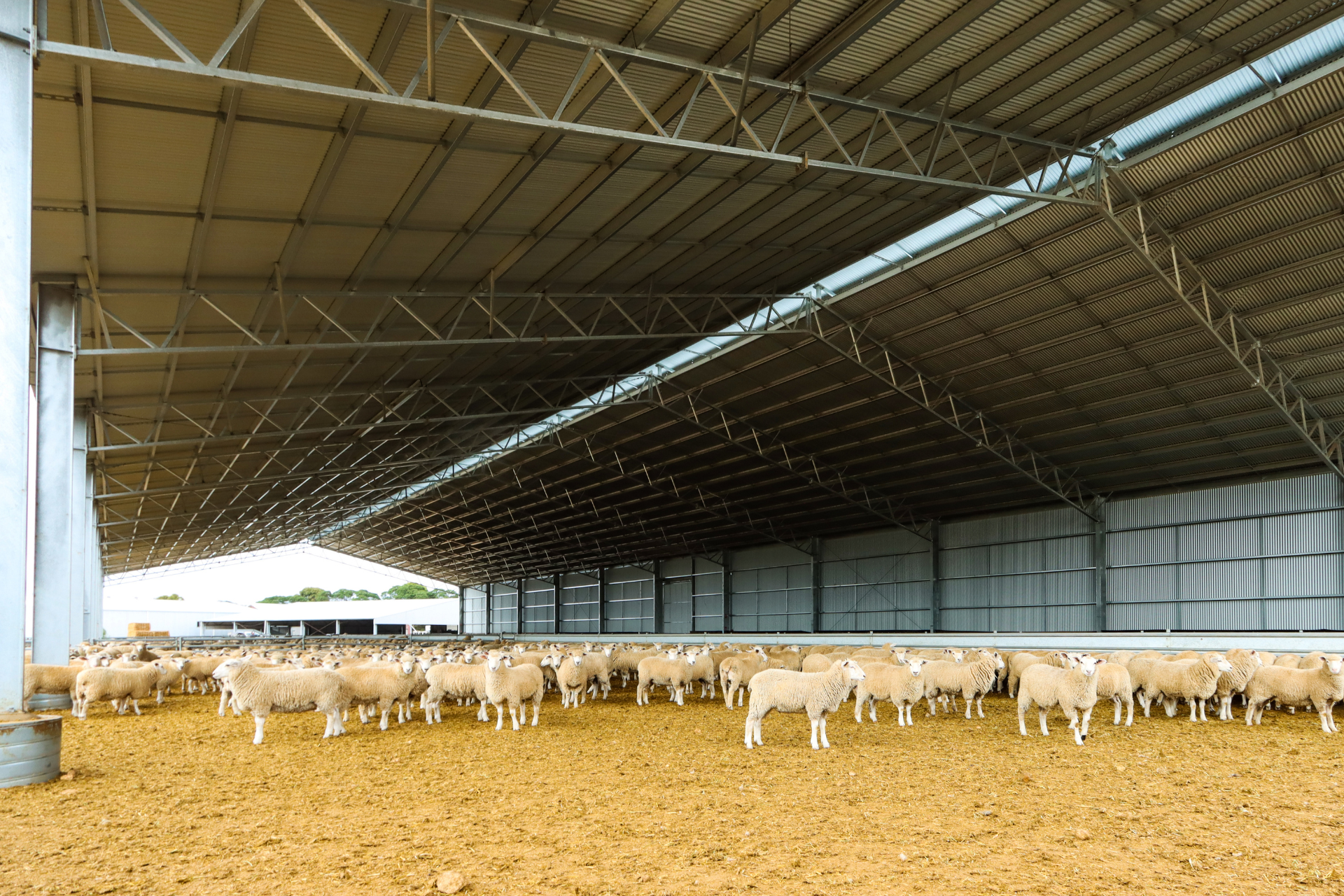
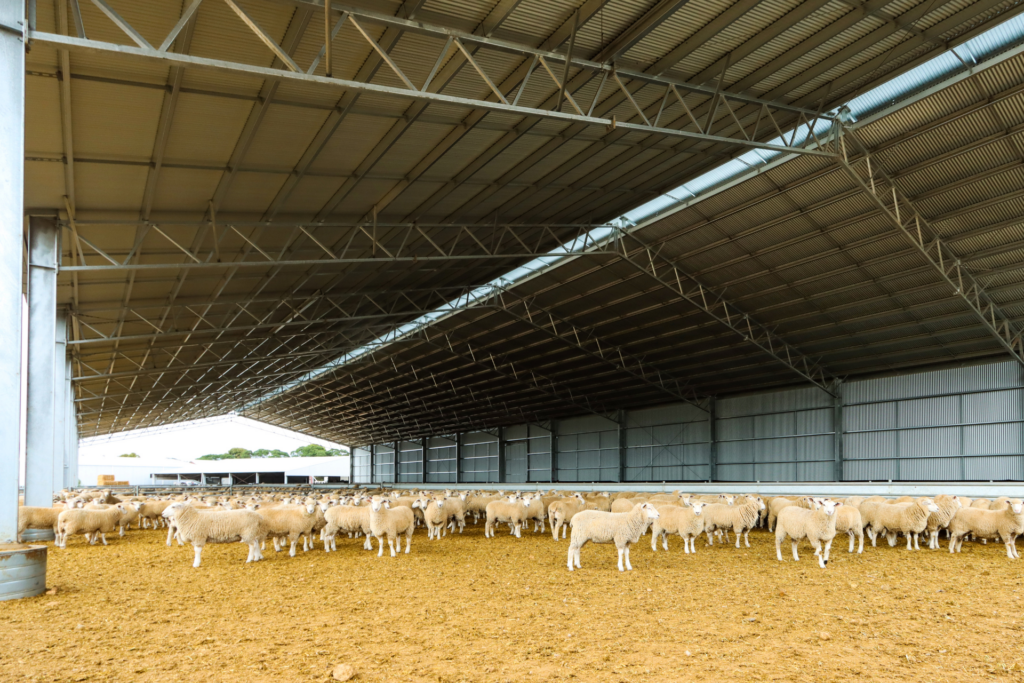
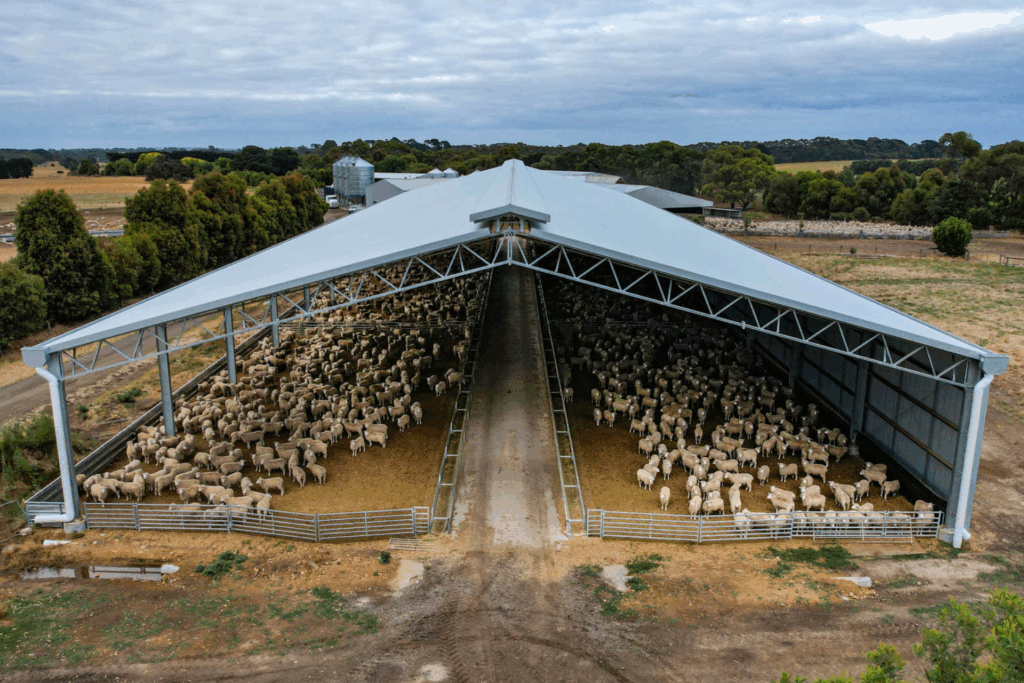
An Action lamb feedlot shed is a structural steel roof designed and built to cover lamb feedlot pens to improve management, animal health, and production.
It includes:
- Heavy-duty UB columns and open web trusses
- Straight gable roof with steep pitch and ridge ventilation
- Best practice spans and bay spacings
2
2. What Are The Benefits Of A Lamb Feedlot Shed?
Covering your feedlot can be a good option for intensive feeding systems.
Some of the top benefits of lamb feedlot sheds include:
- Easier day-to-day management
- More consistent carcase weights
- Faster finishing/quicker turnoff
- Improved lamb health and reduced treatment costs
- Reduced feed wastage
- Capturing stormwater run-off
Whether an intensive lamb feedlot system is the right fit will depend on your operation and what you are looking to achieve.
For example, is this a short-term or long-term venture? Will increasing weight gains and maintaining consistent production open more market opportunities? Is becoming more labour efficient a priority?
3
3. What Is The Best Feeding System For A Lamb Feedlot Shed?
Each sheep feeder system has its advantages and disadvantages.
The best system for your lamb feedlot will depend on:
- Your budget
- How long will the sheep be in the feedlot for
- Operational priorities such as labour efficiency and easy management
- Whether it is a permanent or temporary setup
- Your existing infrastructure
For example, lick feeders offer a lower initial cost but may be more labour intensive and provide inconsistent feed delivery. They are popular choices for smaller-scale set-ups or short-term feeding.
Automated feeders come with a higher initial investment in technology and equipment, but are more labour-efficient and can deliver pre-set rations, providing more control over feed intake. They are a popular option for larger sheep numbers and finishing programs.
The traditional concrete feed bunks are a straightforward set up that works well with a TMR. Feed bunks do need to be filled several times a day, and there can be competition for bunk space. Feed bunks work well for finishing acclimatised sheep and are a popular choice for lamb feedlot sheds, with either a perimeter or centre feed lane for low-stress feeding.
Learn more about your options here – Best Sheep Feeders For Feedlots (Ratings & Reviews)
4
4. Can I Cover Existing Feedlot Pens?
Yes, this is usually possible and can be achieved by:
- Adjusting column lengths to suit any fall or slope over the site
- Varying bay spacings to avoid columns clashing with pens
- Stick building the cover or constructing it to one side and craning into place
5
5. Are There Any Industry Regulations For Lamb Feedlot Sheds?
There is no single set of regulations written specifically for lamb feedlot sheds. However, any lamb feedlot shed will still need to:
- Meet animal welfare requirements, including the Australian Animal Welfare Standards and Guidelines for Sheep, such as providing adequate space, shelter, and reliable access to feed and water.
- Receive relevant council approvals, which may include building permits and planning permits.
For larger-scale feedlot setups, additional requirements may apply around effluent management and fire design.
There are also some industry recommendations for sizing that are considered best practice which we will discuss next.
6
6. What Size Lamb Feedlot Shed Do I Need?
The best size for your lamb feedlot shed will depend on factors like:
- How many sheep do you want to house? What is the stocking rate?
- What type of feeder/system are you implementing?
- Will there be a feed lane? Centre or side?
- Will the feedlot be 100% contained or include external pens?
- Are you covering new or existing pens?
- What are your access requirements?
- Do you have plans to expand the feedlot in the future?
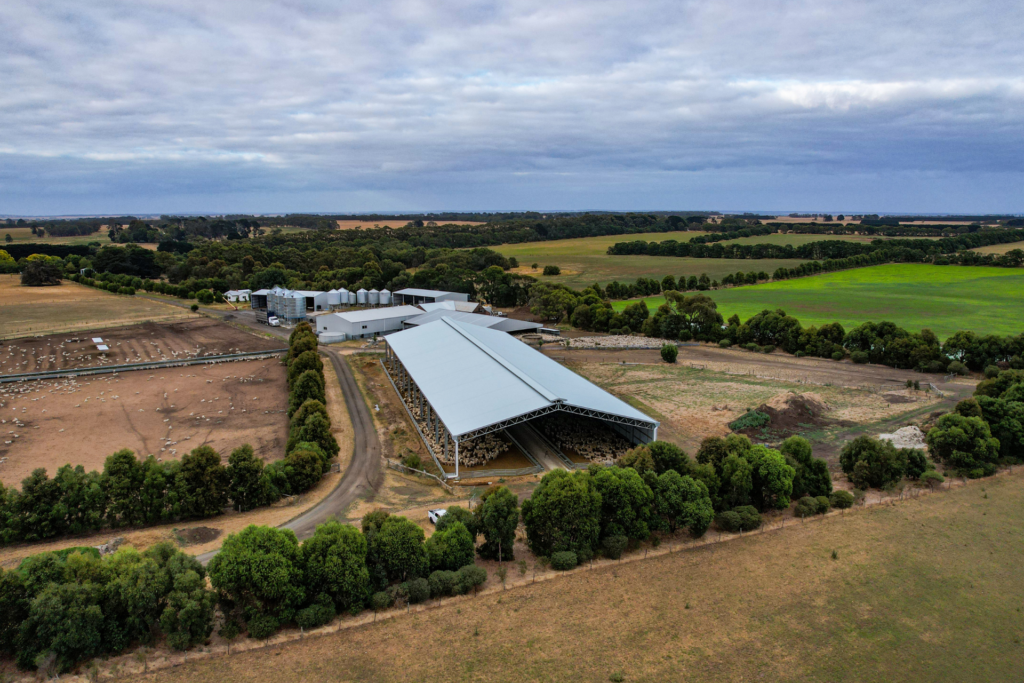
However, there are also some industry recommendations and best-practice rules of thumb to consider:
- A stocking rate of around 1m² is common for covered lamb feedlots, including for partial shade set ups.
- Lambs will require 150mm or more per head of bunk space, or if you are using lick feeders, this reduces to around 50mm.
- An eave height of 5 metres is most common for a covered lamb feedlot. This provides adequate clearance for equipment such as tractors and feed wagons, and also helps facilitate effective airflow through the cover.
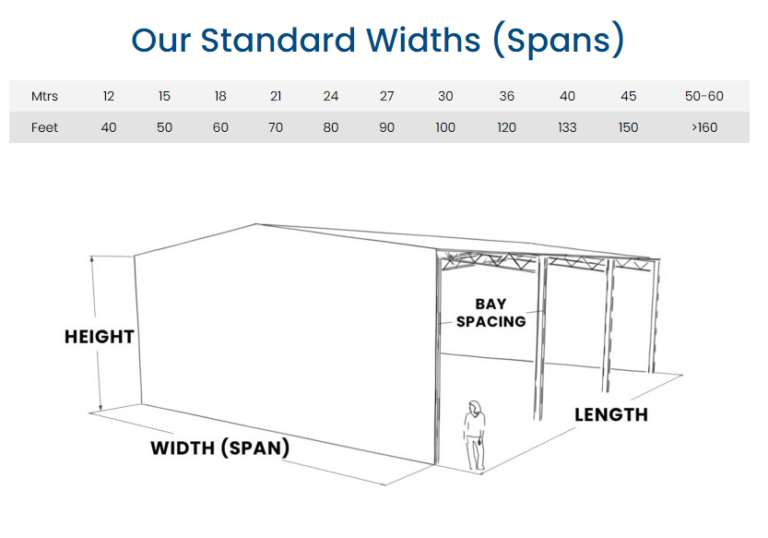
- Several standard spans work well for lamb feedlot sheds, including 24 metres, 27 metres and 30 metres.
- A cantilevered canopy is a cost-effective way to gain extra coverage/width and can be used over side feed lanes.
- The recommended roof pitch for a lamb feedlot is around 18 degrees. This works most effectively with a 1500mm ridge opening.
- Cost-effective and functional bay spacings range from 8 metres to 10 metres. The 10-metre option is common for larger setups for airflow and access (especially if the footings have been formed up).
- Read more here – What Size Lamb Feedlot Cover Do I Need?
7
7. What Is The Best Feedlot Shed Design?
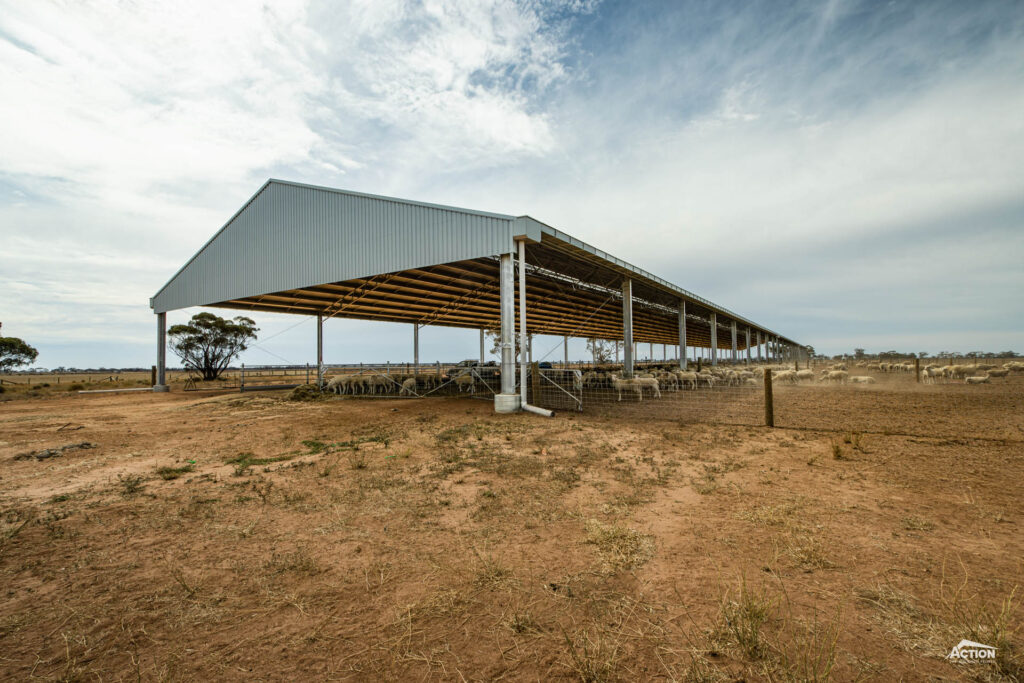
The best lamb feedlot shed design usually starts with a “roof-only” configuration that is then customised to suit your operational requirements (such as feeder type and stocking density) and site conditions (such as the direction of the prevailing weather).
For example, recommended design features include:
- Steep roof pitch (usually between 14 and 18 degrees) that works with an open ridge vent and an Action custom “pop top” ridge cover to provide effective ventilation
- Gable infills, partial walls or walls with sliding doors to achieve practical access and the correct balance of airflow and ventilation
- Stormwater management using the Action custom gutter system (often plumbed to one end)
Other common features include canopies (for cost-effective coverage and convenient column placement) or formed up columns (to lower the risk of injury at sheep level).
8
8. How Can I Customise A Lamb Feedlot Shed?
While there are recommended inclusions for your lamb feedlot shed design, such as a steep roof pitch and ridge ventilation, there are also options to customise your shed to suit your operation.
Popular design options include:
- Cantilevered canopies (often used over side feedlanes)
- Gable infills and partial walls to balance airflow and weather protection
- Formed up footings to protect the columns and reduce injury risk
- Varied bay spacings to work with pen and feeder set up
9
9. What Orientation Does My Lamb Feedlot Shed Need To Be?
Orientation refers to the direction your shed is positioned.
This determines how exposed the shed is to the prevailing weather and will influence how effective your feedlot shed is in providing weather protection and airflow.
Generally, the recommended orientation for feedlot sheds is the east-west orientation.
However, this will depend on factors like:
- The local climate
- Your feedlot shed design. For example, have you included a side wall?
- Site location, such as how exposed it is.
10
10. How Much Does A Lamb Feedlot Shed Cost?
The average cost of a lamb feedlot shed is around $750,000, with prices ranging from $250,000 to $1,400,000.
The lamb feedlot shed cost for your project will depend on factors like size, location and design features included.
As a general rule, a lamb feedlot shed costs around $115 – $150/m², including GST, which works out to be around $150 – $160/head.
The cost per head for your project will depend on factors like stocking rate, loafing areas and shed configuration.
Please note, these price guides do not include site works, drainage or feeding infrastructure, which will influence total project cost.
That’s a wrap on the top lamb feedlot shed questions.
Looking for more information or keen to understand recommended next steps? Talk to the Action team on 1800 687 888.