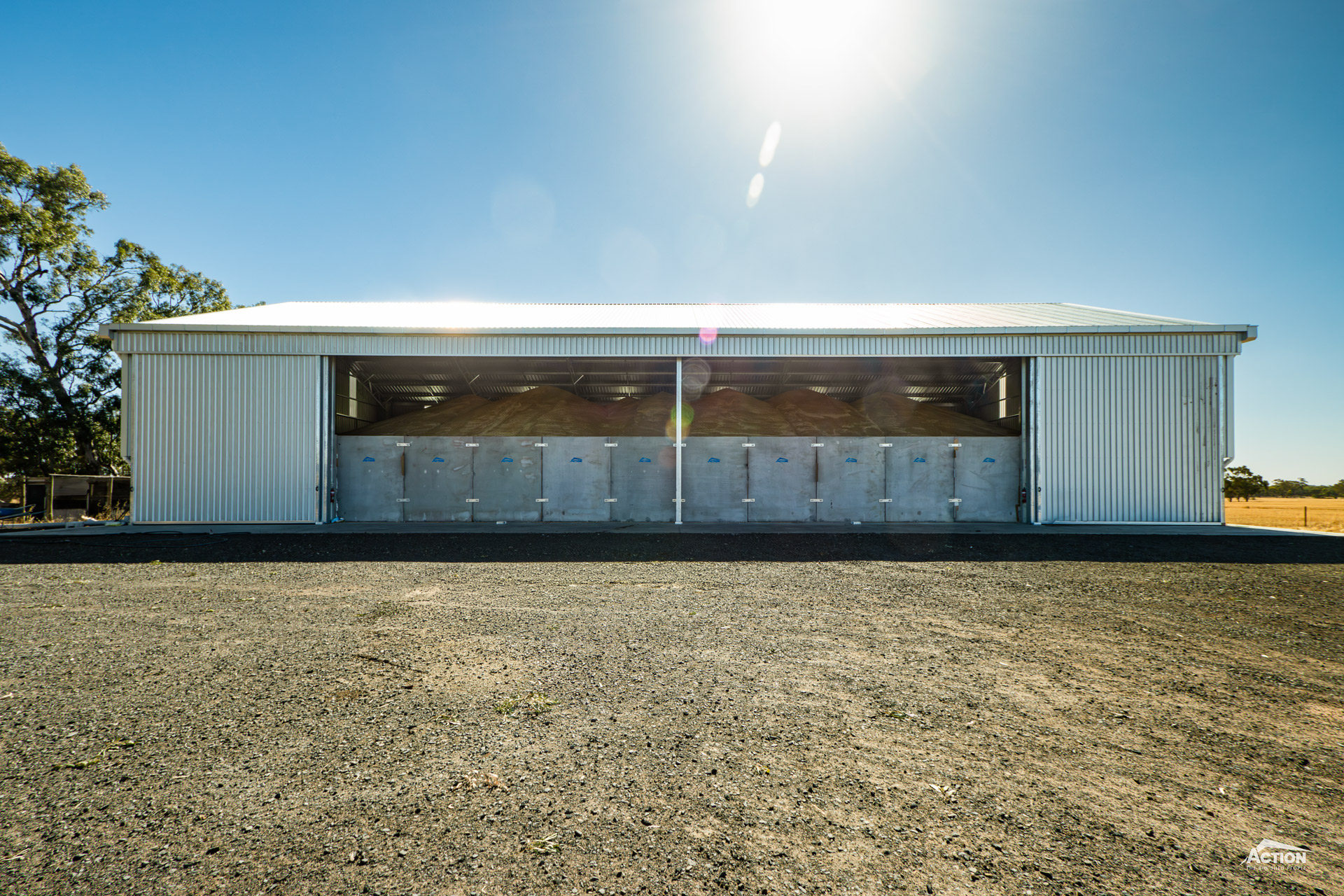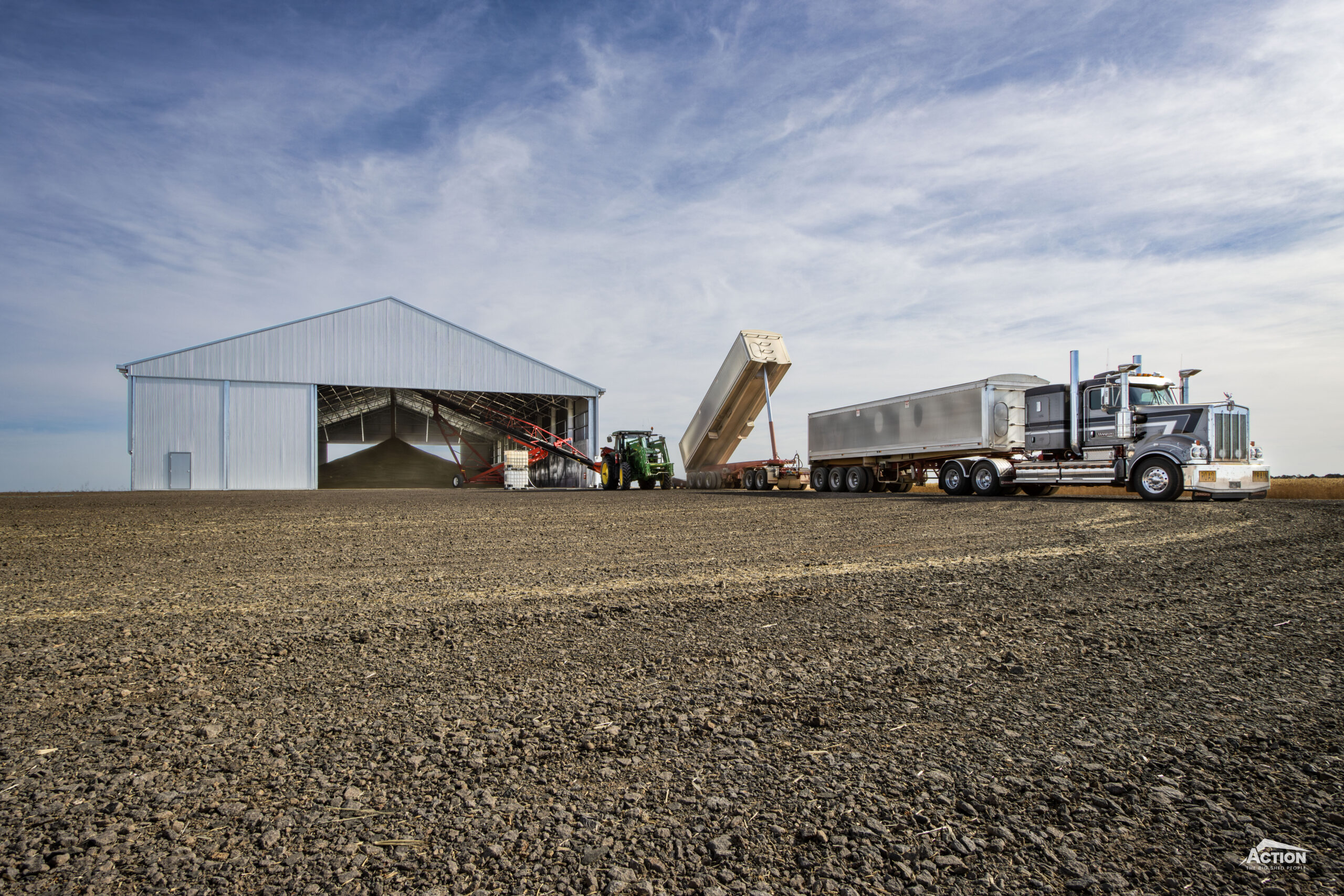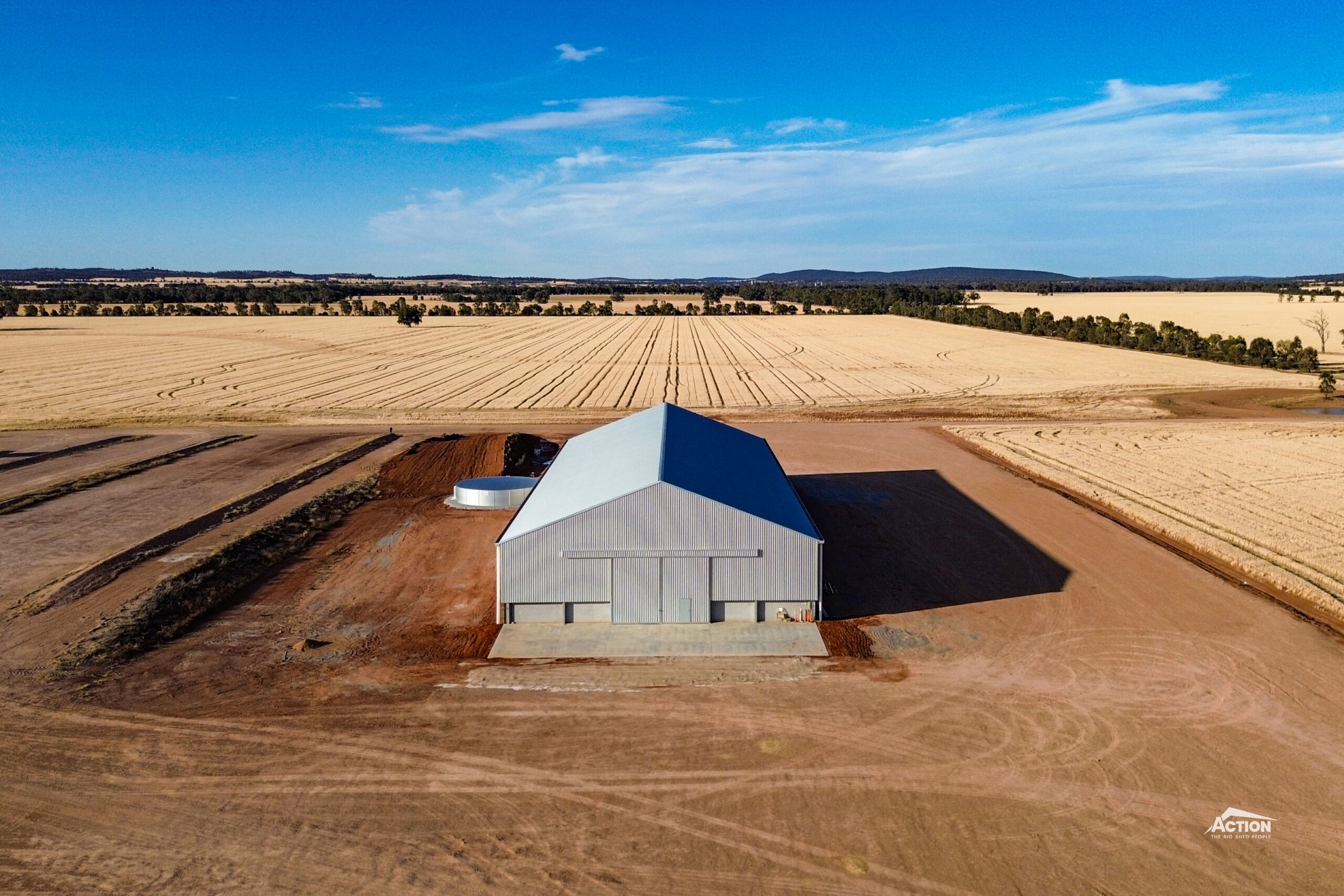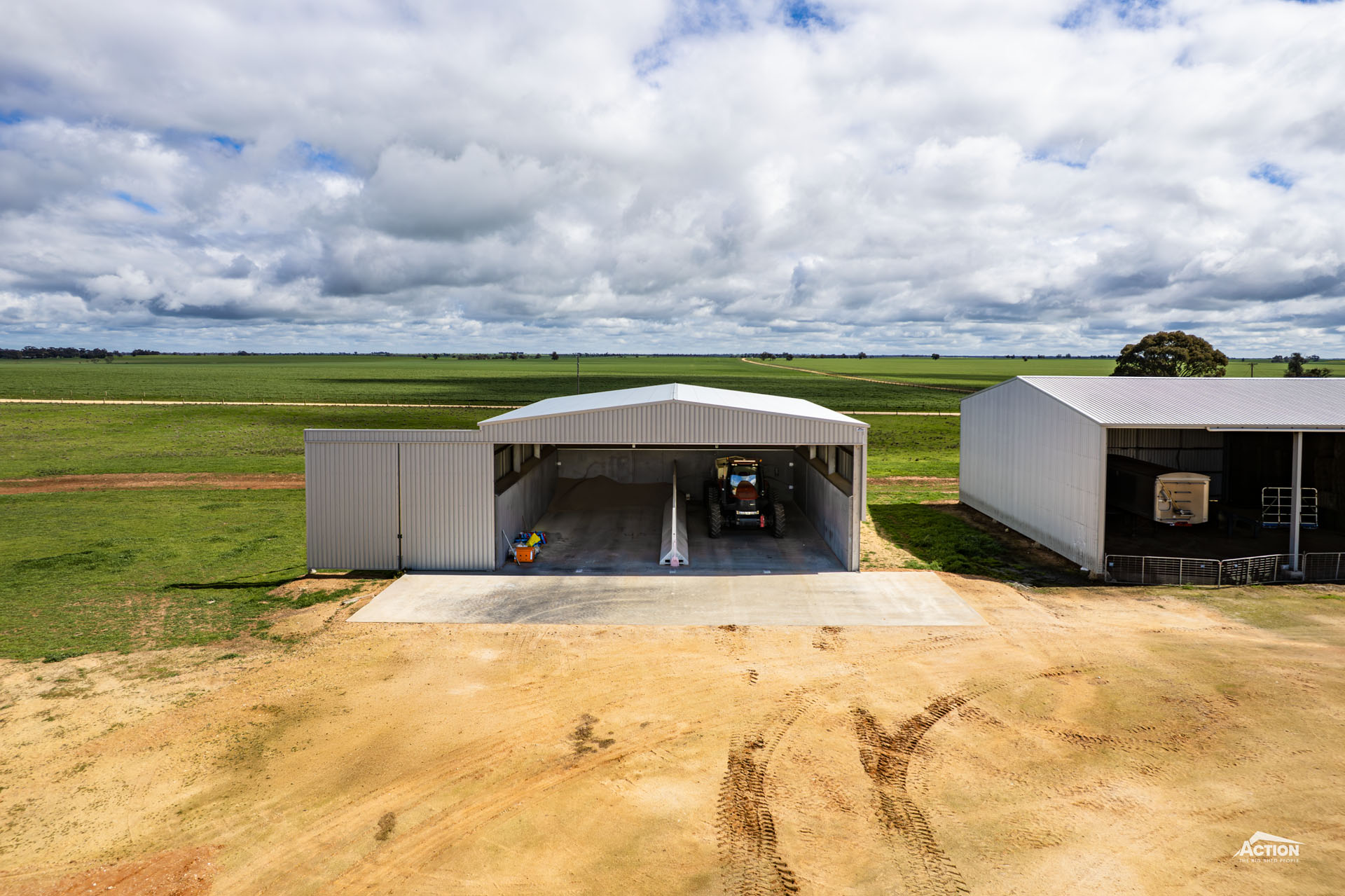
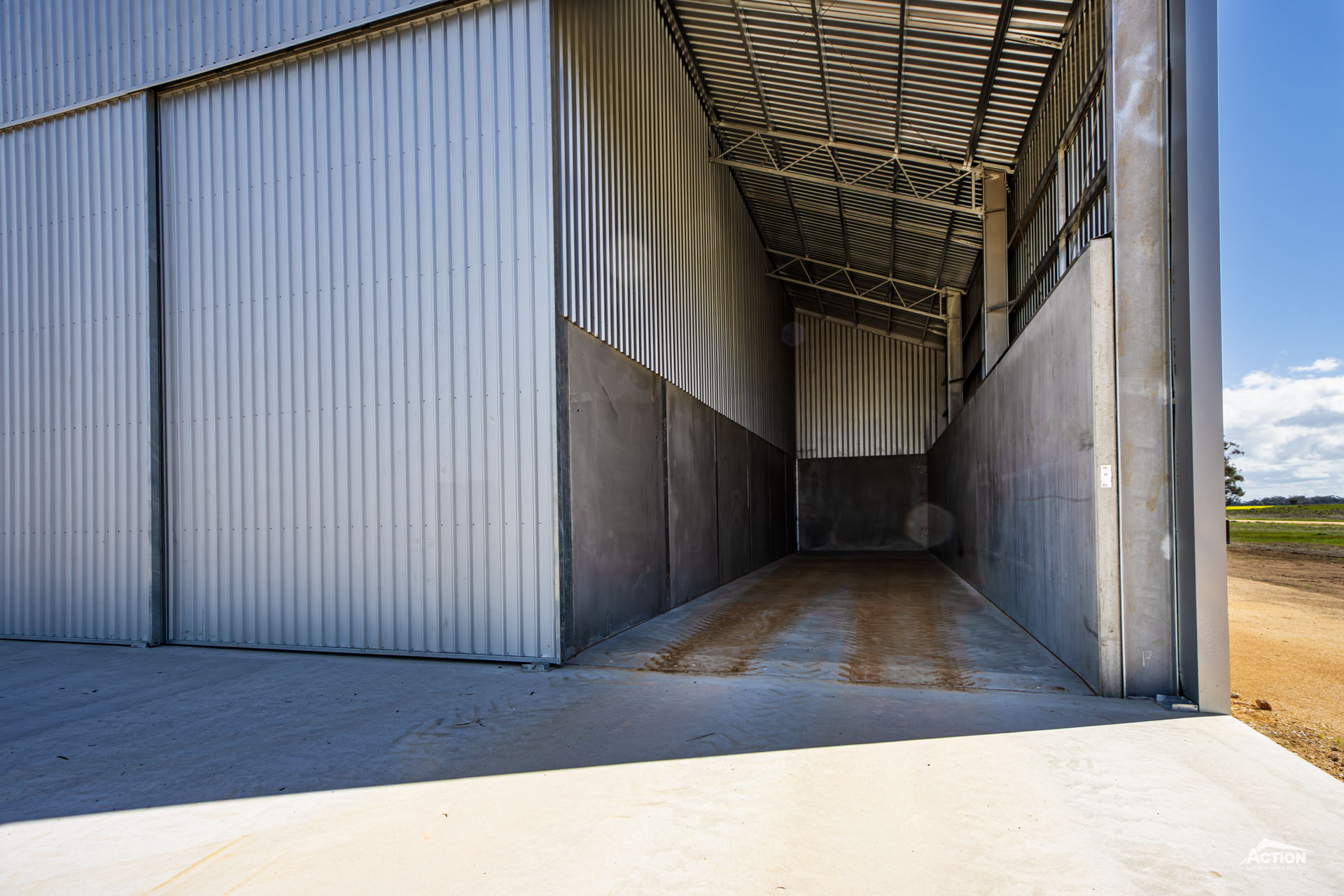
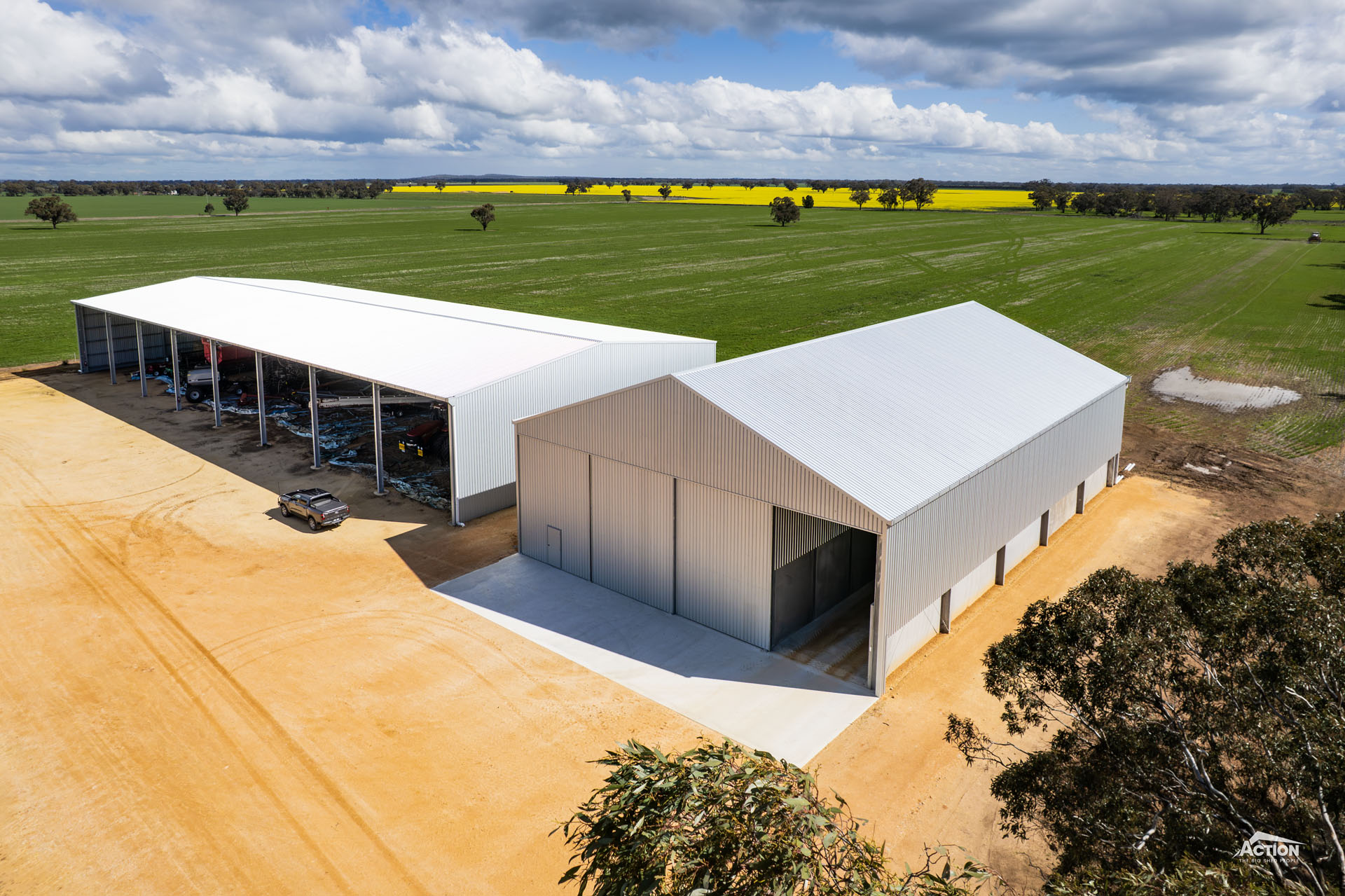
This 2000-tonne segregated grain shed includes a smart solution for on-farm fertiliser storage – a 200-tonne fertiliser bunker.
Read on to discover why the design is effective and find a helpful price guide.
For cropping enterprises, having the right on-farm storage can be the difference between maximising returns and missing opportunities.
Action grain sheds are designed to streamline logistics and avoid frustrating delays at harvest. They also give you the option to store your grain for longer – or buy grain in – and take advantage of ideal market conditions.
Similarly, Action’s Standard Fertiliser Sheds save you time and money at cropping.
However, for growers looking to store a couple of hundred tonnes of fertiliser, a purpose-built fertiliser shed can be a difficult investment to justify (a topic we discuss here).
That’s why many growers consider multi-use sheds as a way to get better value for their money.

Designing a shed that works equally well for grain and fertiliser isn’t always straightforward. The design needs to be functional, safe and effectively segregate products.
This recent Action grain shed project shows that it’s possible.
The segregated grain shed with a fertiliser bunker offers a smart, cost-effective way to combine grain and fertiliser storage in one build. It’s a versatile design that will keep the cropping enterprise ahead of the game by delivering value year-round.
Read on to learn why it works and how much you can expect to pay for a similar project.
Project Overview
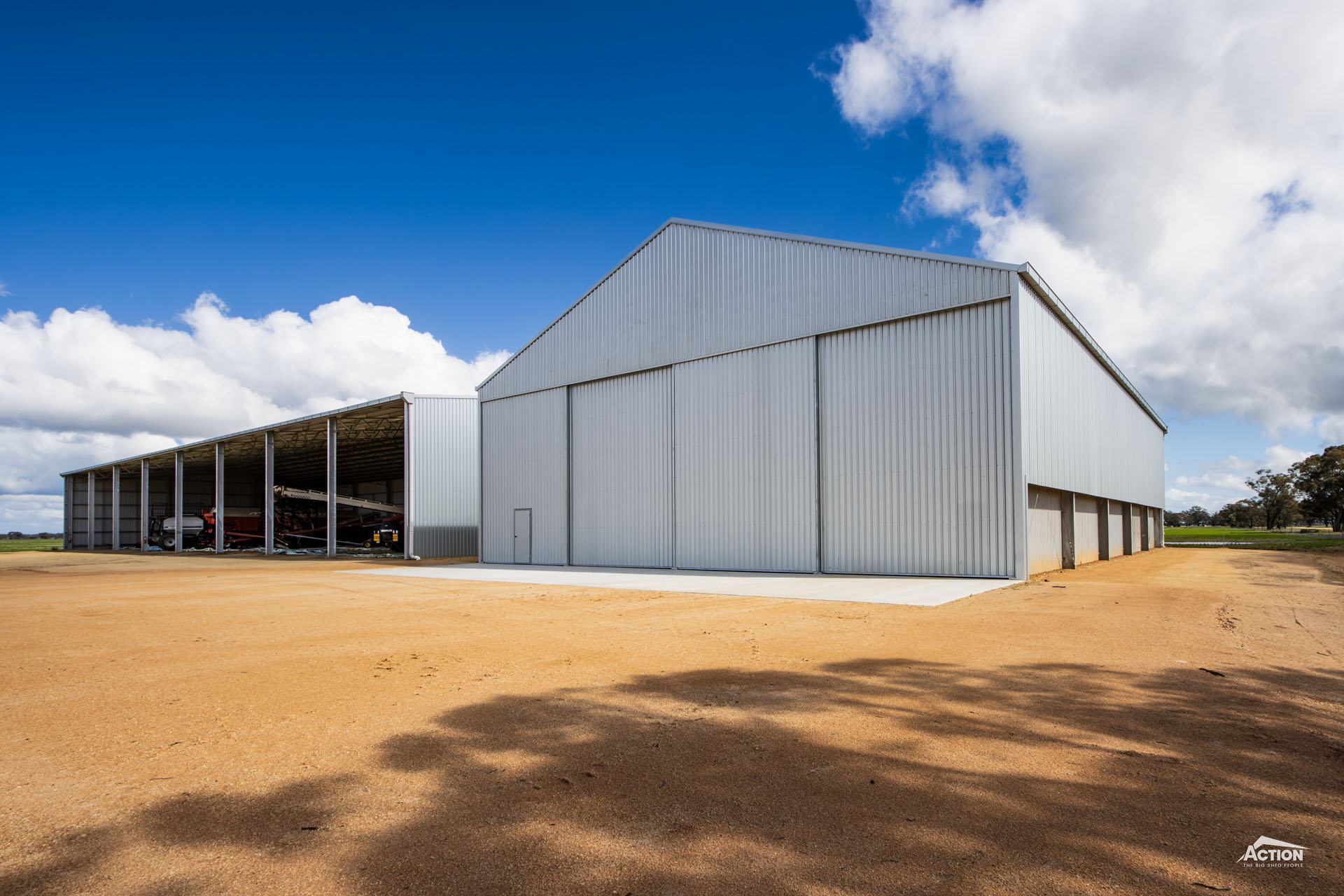
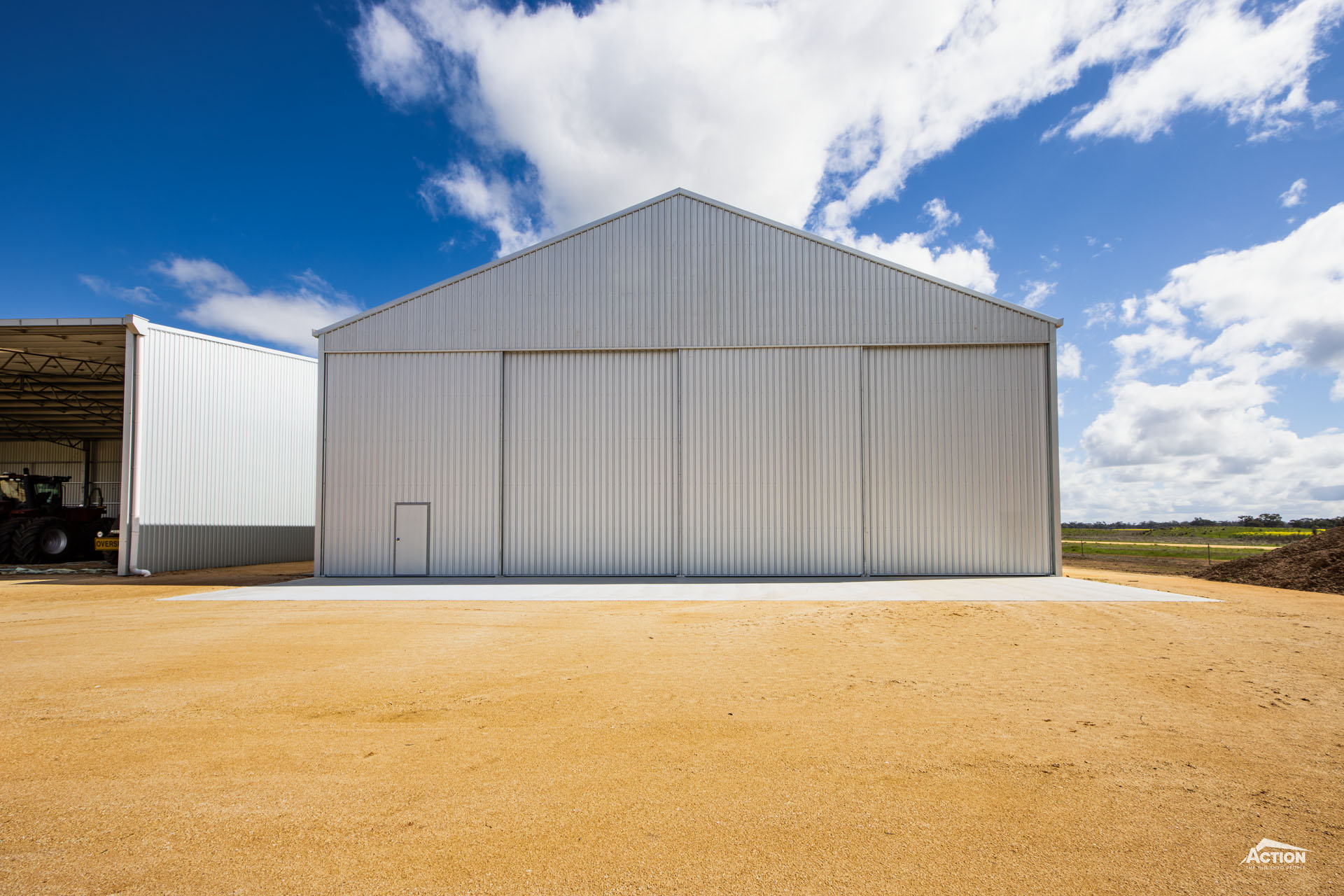
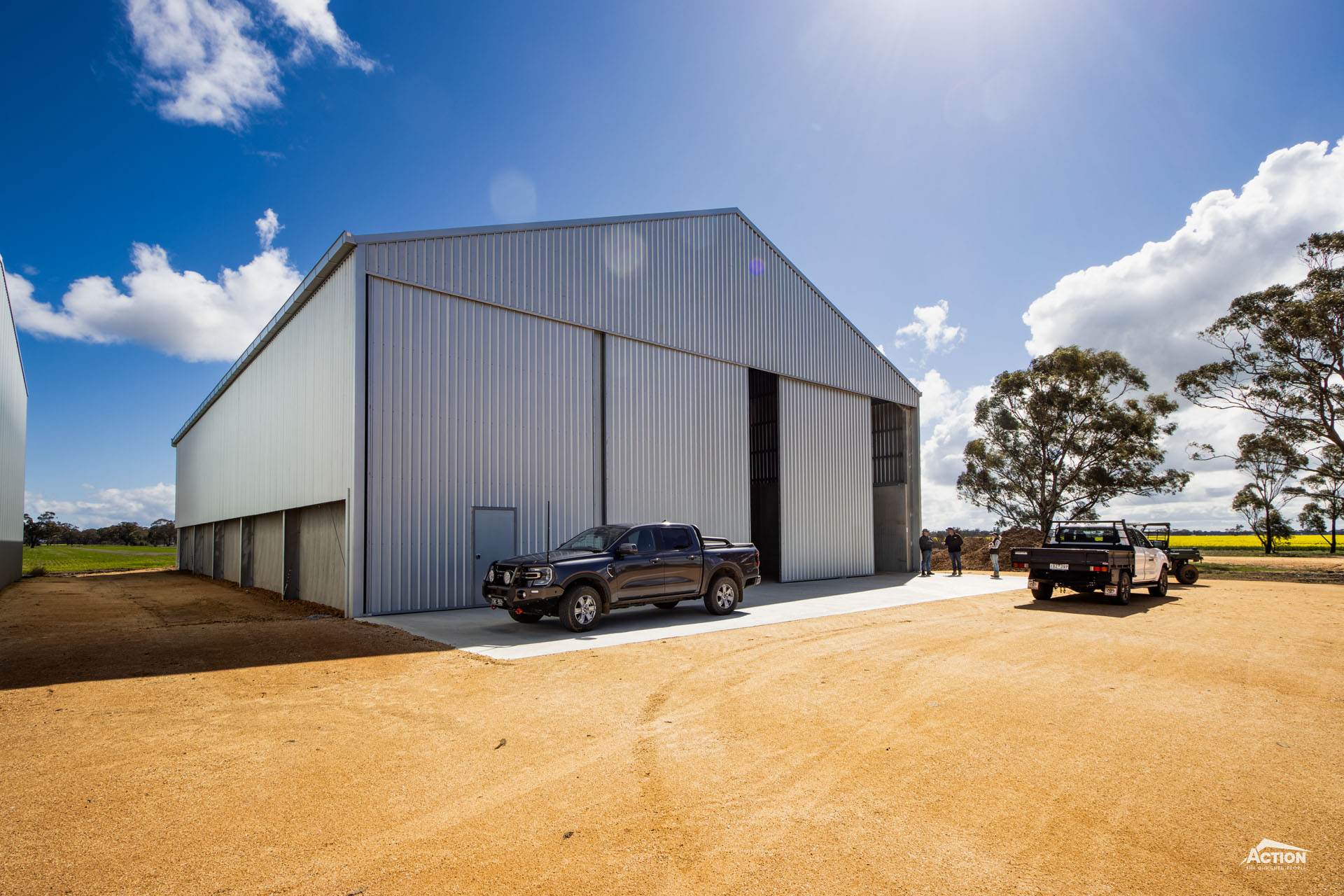
Configuration: Fully enclosed concrete panel shed with a steep roof pitch and a segregated fertiliser bunker.
Size: 32.5m (L) x 21m (W) x 7.5m (H)
Capacity: Approx. 2000 Tonnes (1800 tonnes of grain and 200 tonnes of fertiliser)
The capacity of the shed will depend on the bulk density of the grain and fertiliser being stored. Try the Grain Shed and Fertiliser Shed Calculators here to see how this varies.
Location: Nareewillock
Build Date: 2025
Top 3 Reasons This Segregated Grain Shed Design Works
1
1. Smart Way To Store Fertiliser
Recent fertiliser quality issues and silo failures have reinforced that sheds are the recommended way to store fertiliser on-farm.
Considering your options for storing fertiliser?
This design provides an excellent solution for small-scale fertiliser storage – without the need for an extra shed.
It keeps the fertiliser segregated from the grain storage area and is more cost-effective and versatile than a standalone fertiliser shed.
2
2. Ready For Harvest & Cropping
As we discuss in this article – How To Maximise Grain Shed ROI – designing your grain shed for versatility will ensure the shed delivers value beyond harvest.

This project is a great example of that, working well for both grain storage and fertiliser storage.
This is achieved with details such as:
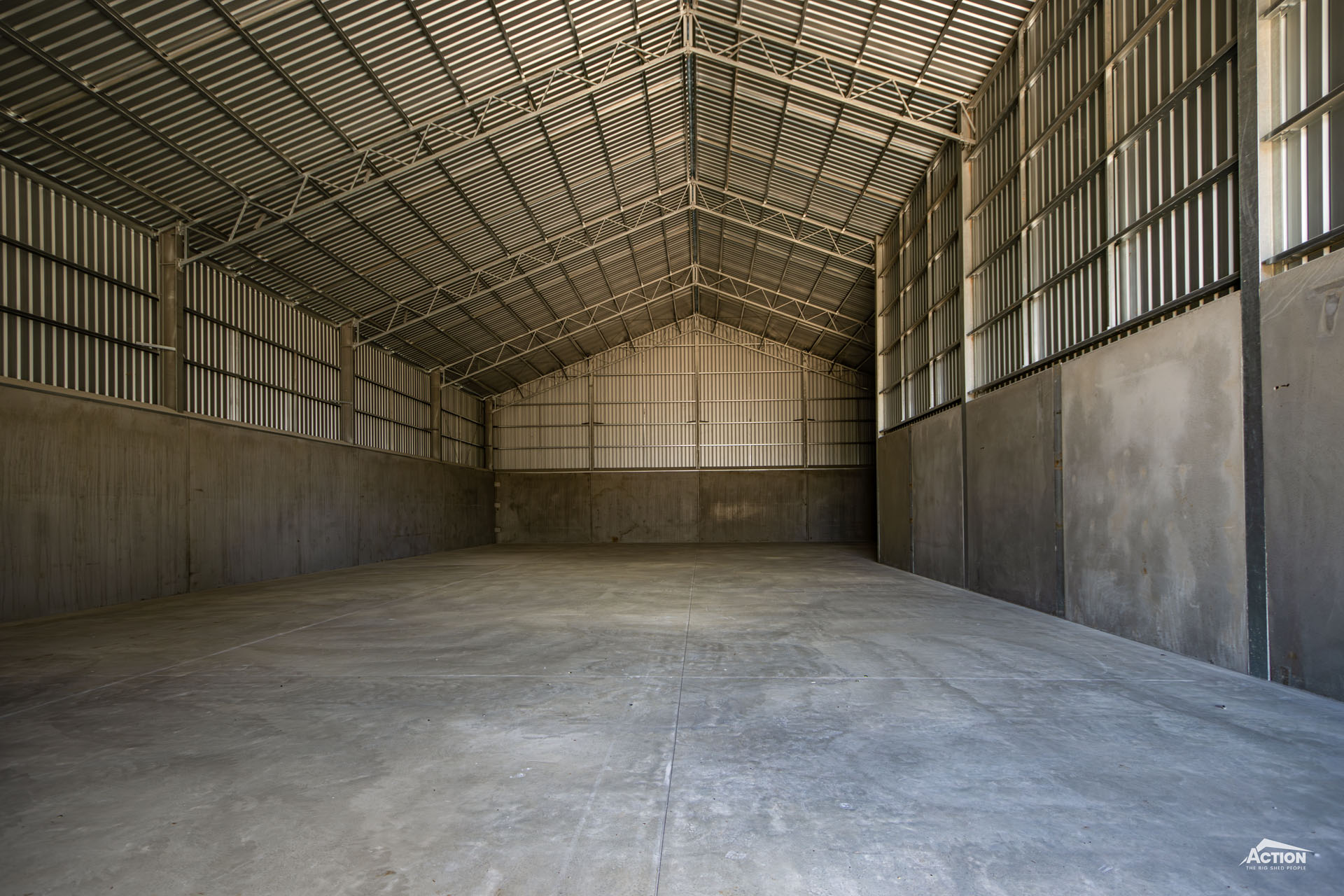
- Steep roof pitch (to accommodate the angle of repose and tipping inside)
- Concrete panel height (uses the recommended 3.5m height)
- Bulk storage area (this can be further segregated with L-walls)
These features allow the shed to be used year-round and season to season, even as storage requirements change.

3
3. Gets The Small Details Right
This segregated grain shed follows best-practice design recommendations
- Fully enclosed configuration
- Concrete panels and slab
- Steep roof pitch
It also gets the small details right for compliant, convenient and cost-effective storage at both cropping and harvest.
And it’s often these details that make the biggest difference.
These include:
- Concrete apron (this keeps the shed accessible in inclement weather, makes loading and unloading more streamlined, reduces wastage and makes it easier to keep the site clean)
- Personal access doors (as well as being a compliance requirement, they allow the shed to be accessed without needing to push open the sliding doors)
- Panel flashing (a standard inclusion on Action grain sheds and fertiliser sheds, to prevent overfilling)
Check out the photo gallery below to view these features in more detail.
Project Gallery

Segregated Grain Shed Price Guide
Planning your on-farm storage for 2026?
Researching segregated grain shed prices?
Budgeting for a 2000-tonne shed?
Here’s a handy price guide.
A similar segregated grain shed project would cost approx. $365,000 – $450,000, including GST, installation and delivery. This also includes the cost of the concrete slab and apron.
This works out to be approx. $180 – $225 per tonne.
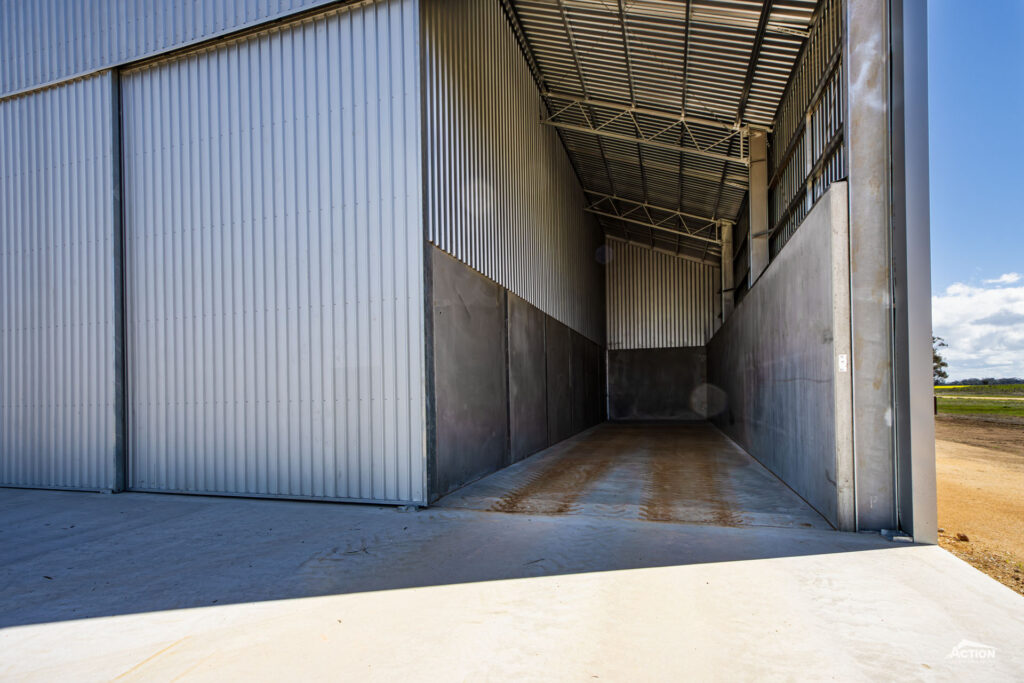
It is worth noting that the segregated bunker will increase the cost per tonne, compared to a 2000-tonne grain shed with one bulk storage area.
This is simply because it increases the cost of the project without providing additional storage capacity.
However, while the per-tonne cost is higher, it is more cost-effective than building a separate fertiliser shed.
For example, a standalone 200 tonne fertiliser shed will cost approx. $625 – $800 per tonne.
Please note that these price guides are approximate only and intended only as a budgeting tool. They do not take the place of a quote. For accurate pricing for your project, please submit a REQUEST A QUOTE form, and we will be in touch!

You might also find the Standard Fertiliser Shed Size & Price Guide helpful.
This range includes options for 200 tonne, 400 tonne, 1000 tonne and 1500 tonne storage.
Frequently Asked Questions About Grain Sheds – Answered
Quick answers to the top questions about Action grain sheds.
The best-practice design for a bulk grain storage shed is a fully enclosed configuration, typically with:
- 3.5m concrete panels
- 180mm thick concrete slab
- 21-degree roof pitch
This can be customised with features such as:
- Concrete aprons
- Cantilevered canopy
- Sliding door outriggers
- Segregating panels
Details such as height and sliding door placement will depend on how you intend to load and unload the shed.
For project-specific design advice, reach out to a building consultant on 1800 687 888.
The grain shed size that you require will largely depend on:
- The type of grain being stored
- The volume of grain being stored
- How you load and unload the shed
For example, you will need to consider the bulk density of the grain. Use the grain storage calculator here to see how bulk density will impact shed capacity.
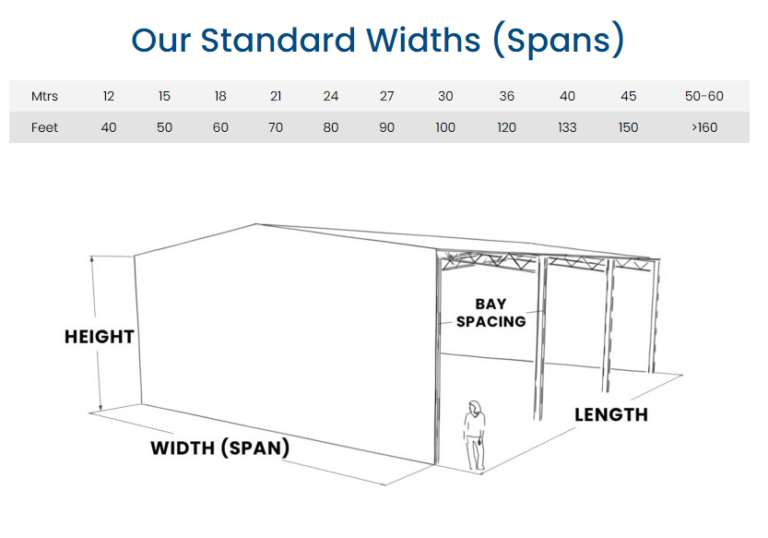
The length of your grain shed will be determined by the bay spacing and the number of bays.
- 6.5 metres is the best-practice bay spacing for grain sheds, as no stub columns are required to support the panel
- Increasing the length of your shed (rather than the width) is a cost-effective way to increase capacity.
For grain shed width there are several standard spans that work well.
- 18 metres is popular for smaller scale storage, 24 metres or 27 metres are most popular for larger scale storage.
- A 27 metre span allows a truck to turn inside the shed.
- Choosing a standard span helps create a cost-effective and functional design, you can learn why here – What Are The Standard Spans For Farm Sheds?
The height and roof pitch need to be considered in conjunction.
- A 21 degree roof pitch accommodates the angle of repose and allows a truck to tip in the shed.
- Popular heights include 7.5m, 8m and 9m.
The building consultants at Action are available to provide advice and costings on sizes that will suit your storage requirements.
The cost for your grain shed project will depend on:
- Size (the bigger the shed the lower the cost per tonne)
- Configuration (longer sheds are more cost-effective than wider sheds)
- How you choose to customise the design
- Location and site conditions
Generally, concrete panel grain sheds usually cost between $100 – $200 per tonne including GST and installation.
Here are some price guides to help with your budgeting:
- A 30m x 18m grain shed stores 1,500 tonnes and costs approx. $150 – $190 / tonne.
- A 36m x 24m grain shed stores 3,000 tonnes and costs approx. $130 – $160 / tonne.
- A 56m x 27m grain shed stores 6,000 tonnes and costs approx. $100 – $135 / tonne.
Learn more here – Grain Sheds Versus Silos (Pros, Cons & Prices)
Yes, generally most grain sheds also work well for fertiliser storage.
However, it is important to maintain a high level of hygiene to prevent contamination.
It would also pay to check that your insurance policy covers a change in use.
Useful Resources
- How To Maximise Grain Shed ROI
- Inside A 2000 Tonne Segregated Fertiliser Shed
- How To Create A Versatile Fertiliser Shed Design
- 2025 Grain Shed Guide (Flipbook)
- Craig Henderson’s 6000 Tonne Grain/Fertiliser Shed (Video)
This 2000-tonne segregated grain shed shows how smart design can deliver extra value.
If you’re planning storage for 2026, talk with the Action team today – the 2026 schedule is already filling quickly! Call 1800 687 888 or REQUEST A QUOTE and we will be in touch!